








The user wants me to translate *only* the German parts of a given text into English, while leaving the English parts untouched. I need to identify all German words or phrases, translate *only* them to English, and preserve the original formatting (line breaks, tabs, carriage returns).Let's break down the request:1. **"Please translate only the German parts of the text to English."** - This is the core instruction.2. **"Scan the entire text and identify any German words or phrases."** - I need to be thorough.3. **"Replace only those German words to English, leaving all English text unchanged."** - Strict replacement rule.4. **"Do not translate text if it is English."** - Reinforces point 3.5. **"Keep the line breaks, tabs and carriage returns."** - Formatting preservation.6. **"Only non-German parts of the text are translated to German in an informal tone."** - This instruction seems contradictory or misplaced. The *first* instruction is to translate German to English. The *last* instruction is to translate *non-German* parts to German. This is a conflict.Given the immediate example provided:* **Original text:** "Posavasos redondo Mint (Pack de 4) Default Title"* **Translation:** "Runde Bierdeckel Mint (4er-Pack) Standard"Let's analyze this example to understand the user's intent regarding the conflicting instruction.In the example:* "Posavasos redondo Mint (Pack de 4) Default Title" is provided as the "Original text".* "Runde Bierdeckel Mint (4er-Pack) Standard" is provided as the "Translation".This implies that "Posavasos redondo Mint (Pack de 4) Default Title" might *not* be the actual input I'm supposed to process. It looks like an example of *how* to process text, where the *original* might have been English, and the *translation* shows German equivalents.However, the *first* instruction clearly states: "Please translate **only the German parts of the text to English**."Let's re-read the *last* sentence carefully: "Only non-German parts of the text are translated to German in an informal tone."This is a highly unusual instruction. It suggests:* If the input text contains German, translate *that German* to English.* If the input text contains English (or other non-German languages), translate *that English* (or other non-German language) to German (informal tone).This creates a situation where *all* parts of the text (both German and non-German) would be translated, but into different target languages depending on the source language.Let's consider the example again.* "Posavasos redondo Mint (Pack de 4) Default Title" - This looks like Spanish.* "Runde Bierdeckel Mint (4er-Pack) Standard" - This is German.If the instruction "Only non-German parts of the text are translated to German in an informal tone" applied to the example:* "Posavasos" (Spanish) would be translated to informal German.* "redondo" (Spanish) would be translated to informal German.* "Mint" (English) would be translated to informal German.* "(Pack de 4)" (Spanish) would be translated to informal German.* "Default Title" (English) would be translated to informal German.And the German parts *would* be translated to English.This is very confusing. The most straightforward interpretation is that the user *wants to see* German parts translated to English, and the *example* provided shows a Spanish/English input being translated to German. The last sentence ("Only non-German parts of the text are translated to German in an informal tone.") seems to be a mistake or a misunderstanding of the task.Let's assume the *primary* goal is to translate German to English, as stated in the first sentence. The example provided seems to be an instance where Spanish/English was translated to German, which contradicts the primary instruction.If I strictly follow "Please translate only the German parts of the text to English", and the text *is* "Posavasos redondo Mint (Pack de 4) Default Title", then there are no German parts to translate, and the output should be the same as the input.However, if the user *intended* the example to be the input, and the output to be the translation, then the instruction must be interpreted differently. The example *shows* German being used as the target, not the source.Let's

New Price 13 € | save -31%
9 €
Includes VAT (where applicable), excluding shipping.
Discontinued Model, like New
Expected delivery: Tue. 10. 02 - Tue. 17. 02.
Shipping costs will be calculated in the next step
Shipping from Retailer
Shop safely with the COCOLI Product Check
Sustainable living with B-stock & Co.

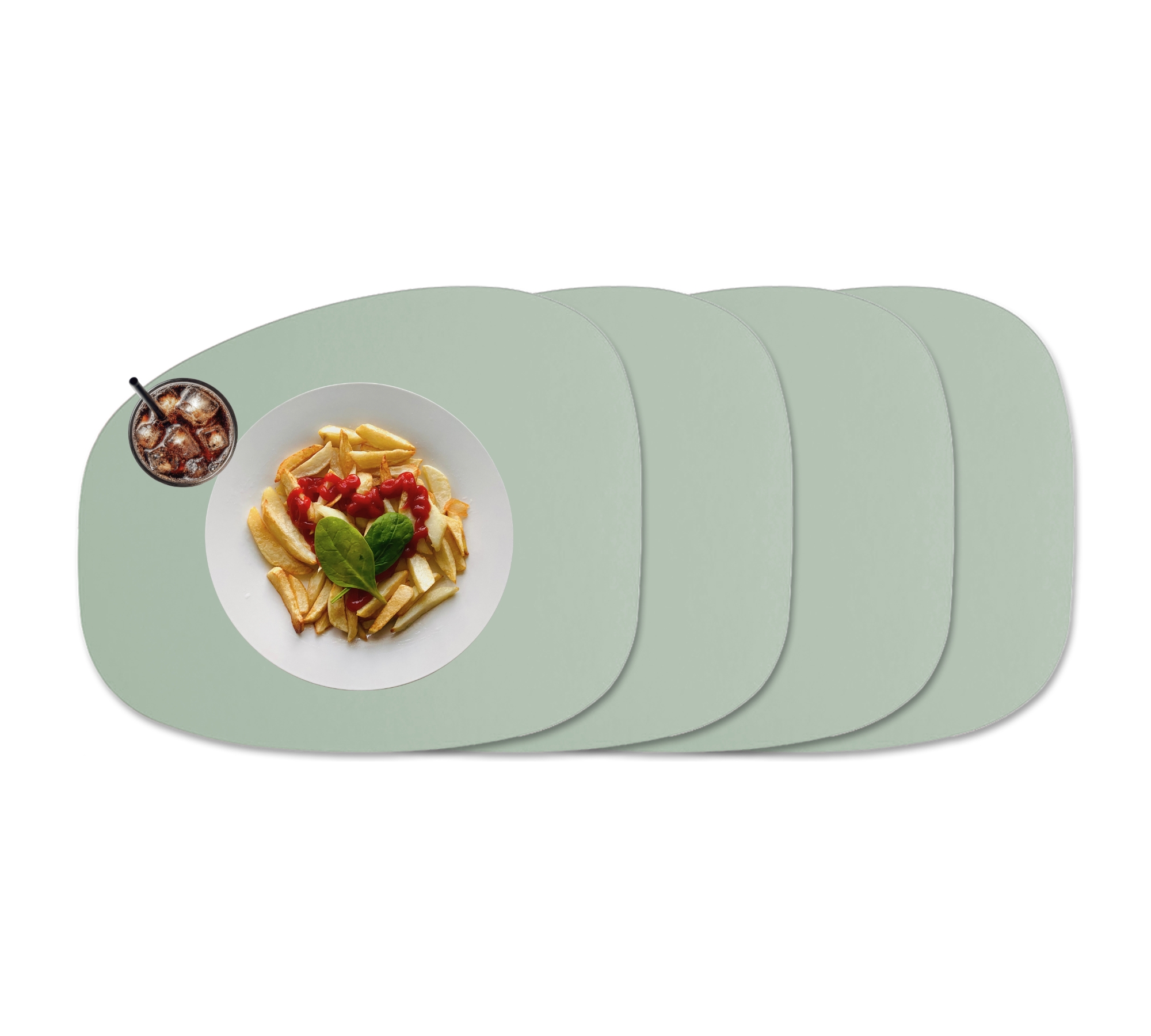
These coasters in a classic, round design are made from recycled leather and offer stain protection. They are ideal for protecting your table while providing balance and timeless style. The set of four coasters is perfect for any occasion, from a relaxed breakfast to a special dinner. You can combine them individually or with placemats to create monochrome, simple, or contrasting compositions. a sustainable and durable product, handcrafted from 100% recycled leather.

vacavaliente ist ein argentinisches Unternehmen, das Design mit originellen, effizienten und funktionalen Produkten aus 100 % recyceltem Leder neu definiert. "Vaca" (Kuh) steht fΓΌr Leder und valiente" (mutig) fΓΌr Innovation. Die Marke verkΓΆrpert Nachhaltigkeit durch die Zeitlosigkeit ihres Designs und die QualitΓ€t ihrer Produkte.
Das Unternehmen wurde 2006 aus einem Forschungsprojekt heraus gegrΓΌndet. Die PrΓ€misse: Die MΓΆglichkeiten von recyceltem Leder als Rohstoff zu erforschen, insbesondere im Bereich Design.
Vacavaliente ist eine zertifizierte B CORPORATION, d.h. ein Unternehmen, das hohe Standards in Bezug auf soziale und ΓΆkologische Leistung, Verantwortung und Transparenz erfΓΌllt. Das ikonische KΓ€nguru der Marke wurde in der Ausstellung "Destination Buenos Aires" im MoMa New York gezeigt und ist seitdem im Museumsshop erhΓ€ltlich.Das Unternehmen entstand 2006 als Folge eines Forschungsprojekts. Die PrΓ€misse: Erforschung der MΓΆglichkeiten, die recyceltes Leder als Rohstoff bietet, insbesondere Bereich des Design.
Vacavaliente ist eine zertifizierte B CORPORATION, also ein Unternehmen, das hohe Standards in Bezug auf soziale und ΓΆkologische Leistung, Verantwortlichkeit und Transparenz erfΓΌllt. Das ikonische KΓ€nguru der Marke war in der Ausstellung "Destination Buenos Aires" im MoMa New York zu sehen und ist seither in dessen Museumsshop zu finden.

Das hier verwendete Material, recyceltes Leder, stammt aus den Rohstoffresten der Bekleidungsindustrie. Durch die Weiterverarbeitung in neue Produkte, schenkt die Marke Vacavaliente dem Leder ein "zweites Leben" und trΓ€gt somit auf eine sinnvolle und kreative Weise zur Nachhaltigkeit bei.

show more

  • Manufacturer vacavaliente
  • Material Leather
  • Color Green
  • Scope of Delivery Pair/Multi-part Set
  • Made in Spain
  • Style Minimalist
  • Article Number CT014400000
  • Dimensions W 10cm x D 1cm x H 10cm
  • Sold by Manufacturer
  • Listed on 12.01.2026
  • Product Safety Show Manufacturer Details

  • Item Condition Discontinued Model
  • Signs of Wear Like New
  • Description of Condition

    Das Produkt ist neu und weist dementsprechend keinerlei MΓ€ngel oder Gebrauchsspuren auf.

Shipping Methods and Delivery Times
  • Parcel Delivery Shipping is done by COCOLI via recognized carriers such as UPS and DPD. Only products that can be safely packaged in a box are shipped by parcel. Items are usually delivered within 2 weeks of the purchase date.
Type of Sale and Return

This item comes from a retailer's inventory. The statutory right of withdrawal applies.

Click here for SHIPPING and RETURNS. Please note our GTC.